
Illinois Court Structure
Article VI of the Illinois Constitution of 1970 establishes a unified three-tier judiciary: the Circuit Court, the Illinois Appellate Court, and the Supreme Court of Illinois. The Circuit Courts are the trial courts of general jurisdiction. The Appellate Court is the intermediate appellate court. The Supreme Court is the state's highest court. The 19th Circuit's official structure page walks through this framework.
Lake County belongs to the Nineteenth Judicial Circuit, which is coterminous with the county. The Illinois Courts directory places Lake County in District 2, Circuit 19. Appeals from Lake County Circuit Court go to the Illinois Appellate Court, Second District, located in northern Illinois, before any further review by the Supreme Court of Illinois.
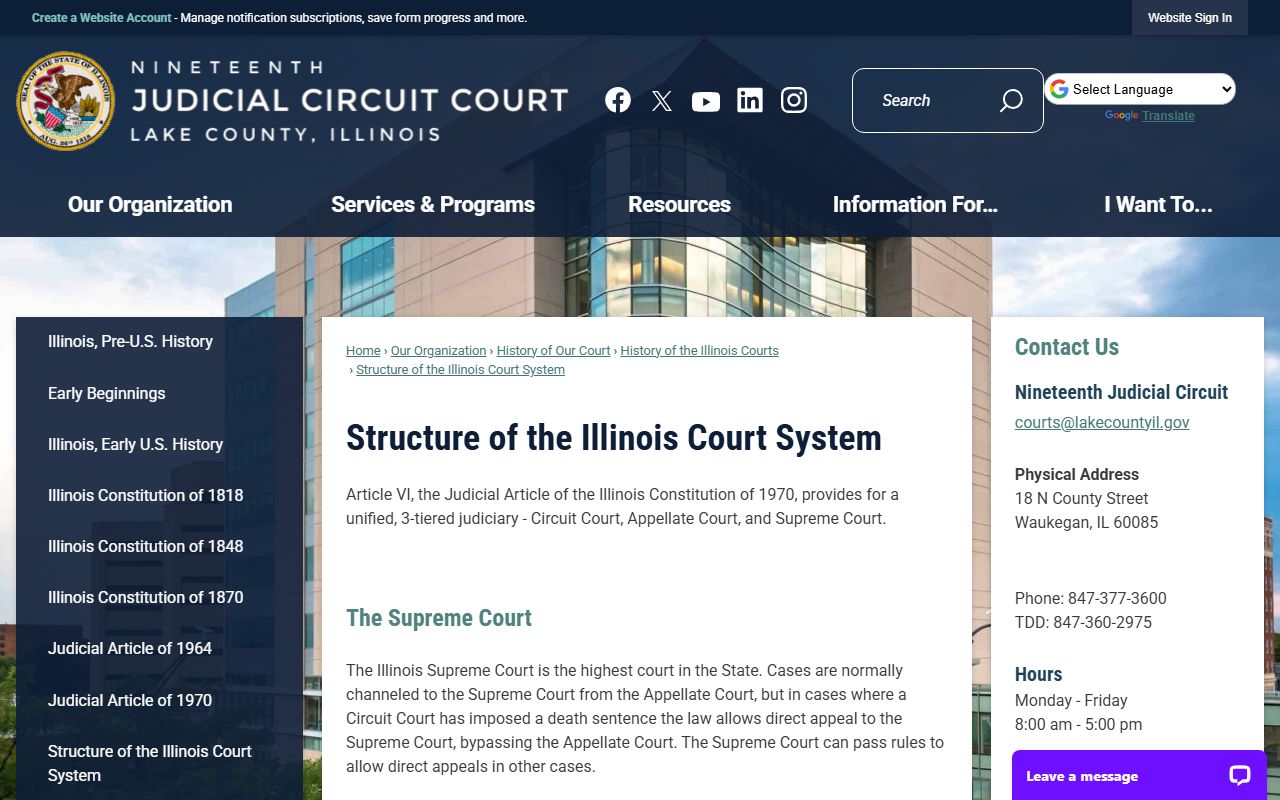
The Illinois Courts page above publishes the three-tier diagram, judicial circuit boundaries, and a short summary of trial-court jurisdiction.
The 19th Judicial Circuit
The 19th Circuit reports 16 circuit judges and a long roster of associate judges. Listed circuit judges include Chief Judge Daniel B. Shanes, Deputy Chief Judge Patricia S. Fix, and Circuit Judges Christen L. Bishop, James K. Booras, R. Christopher Ditton, John L. Joanem, Mark L. Levitt, Sharmila K. Manak, Reginald C. Mathews, Michael G. Nerheim, Jorge L. Ortiz, and Victoria A. Rossetti. Associate judges include Gabriel J. Conroe, Patricia L. Cornell, Matthew J. DeMartini, Stephen M. DeRue, Ari P. Fisz, Bolling W. Haxall, Daniel L. Jasica, Ruth H. Lofthouse, D. Christopher Lombardo, Jacquelyn D. Melius, Deborah J. Menas, Christopher B. Morozin, James Newman, Paul B. Novak, Veronica M. O'Malley, George T. Pappas, Helen S. Rozenberg, Stacey L. Seneczko, James K. Simonian, George D. Strickland, and Donna-Jo Vorderstrasse.
The court runs divisions and courtrooms for civil, criminal, family, probate, juvenile, traffic, arbitration, mediation, branch matters, and specialty courts. There is no separate district court or county court hearing Lake County trial cases. Municipal ordinance violations may be handled through branch courts or through municipal administrative systems outside the state trial court, but the state trial court remains the Circuit Court.
How a Case Moves Through the System
The flow below tracks a typical Lake County case from filing through final review.
Case flow: Circuit Court (Lake County, 19th Circuit) › Illinois Appellate Court, Second District › Supreme Court of Illinois (limited review).
Criminal cases enter through the Criminal Court Tower at 301 Washington Street; civil and family cases enter through the main courthouse at 18 N County Street. Probate cases are heard in Probate Courtroom C-201 in the main courthouse. Juvenile cases sit at the Robert W. Depke Juvenile Complex Center in Vernon Hills. After a final order, a notice of appeal triggers transfer of the record to the Second District. Most cases end at the appellate stage.
Lake County Court Locations
The court runs from a downtown Waukegan campus and several branch courts spread across the county. Each location has its own phone number and case mix. The list below covers the public-facing addresses and what each handles.
| Court / Location | Address | Phone |
|---|---|---|
| Lake County Courthouse | 18 N County Street, Waukegan | 847-377-3600 |
| Clerk of the Circuit Court | 18 N County Street, Waukegan | 847-377-3380 |
| Criminal Court Tower | 301 Washington Street, Waukegan | 847-377-3600 |
| Waukegan Branch Court | 18 N County Street, Waukegan | 847-377-3380 |
| Mundelein Branch Court | 105 E Route 83, Mundelein | 847-377-3300 |
| Park City Branch Court | 301 Greenleaf Street, Park City | 847-377-3500 |
| Round Lake / North Branch | 1792 Nicole Lane, Round Lake | 847-377-3400 |
| Juvenile Branch (Depke Center) | 24647 N Milwaukee Ave, Vernon Hills | 847-377-7888 |
Divisions and Specialty Courts
The 19th Circuit organizes its trial work into divisions and specialty programs. Family Division courtrooms C-101 through C-107 hear dissolution, custody, parentage, and protective order matters. Civil Law Division courtrooms on the second and third floors handle non-family civil cases. The Probate Division uses Courtroom C-201. The Juvenile Branch handles delinquency, abuse, and neglect cases at the Depke Center.
Specialty courts include Drug Court and Veterans Court, both linked in the Illinois Courts directory. These problem-solving courts use judicial supervision, treatment, testing, and graduated sanctions. The State's Attorney's Restorative Justice and Training unit, led by Chief Deputy Karen Levi, supports expansion of specialty courts, diversion, and deflection.
Mediation and arbitration programs cover civil mediation, family mediation, mortgage foreclosure mediation, small claims mediation, and eviction mediation. The Center for Self-Representation in the Law Library helps self-represented filers across these programs.
Illinois Appellate Court, Second District
Appeals from Lake County Circuit Court go to the Illinois Appellate Court, Second District, located in northern Illinois. The Second District covers a multi-county region including Lake, McHenry, Kane, DuPage, and several other counties. After a final order in the Circuit Court, a party can file a notice of appeal and transfer the record. The Appellate Court reviews legal errors based on the trial-court record.
The Supreme Court of Illinois rarely takes cases from Lake County directly. Most reviews end at the Second District. Constitutional questions, certified questions, and limited categories can move on to the state Supreme Court.
Federal Court Difference
The Lake County Circuit Court is a state trial court. Federal cases tied to Lake County go to the U.S. District Court for the Northern District of Illinois, which is a federal trial court. Federal bankruptcy cases go to the U.S. Bankruptcy Court for the Northern District of Illinois. Federal appeals from the Northern District go to the U.S. Court of Appeals for the Seventh Circuit.
Federal records are accessed through PACER, not the Circuit Clerk's portal. The Circuit Clerk does not hold federal records. A criminal case prosecuted by the U.S. Attorney for the Northern District of Illinois never appears in the Lake County Circuit Clerk's portal.
Comparing the Circuit Court With Other Tribunals
Lake County does not run a county court or justice court for trial cases. The comparison table below contrasts the state Circuit Court with the federal trial courts that also cover Lake County.
| Topic | Lake County Circuit Court | U.S. District Court (N.D. Ill.) |
|---|---|---|
| Court system | State court (19th Circuit) | Federal court (Northern District of Illinois) |
| Case types | Civil, criminal, family, traffic, probate, juvenile | Federal civil and criminal, diversity, federal question |
| Records custodian | Clerk of the Circuit Court | U.S. District Court Clerk (PACER) |
| Appeals | Illinois Appellate Court, Second District | U.S. Court of Appeals, Seventh Circuit |
| Local address | 18 N County Street, Waukegan | Chicago federal court complex |
For the appeals side, the federal Seventh Circuit page is linked below.
Brief History of Lake County Courts
Lake County court started in a Libertyville schoolhouse. The county seat moved to Little Fort - later renamed Waukegan - in 1841, and court relocated to the Kingston Building on the bluff. The county's first courthouse land was purchased using $200 in gold loaned by Elmsley Sunderlin, who supported moving the seat to Waukegan. The current courthouse complex was dedicated May 1, 1970 after 1,282 working days of construction. The 1986 Jail and Courts Building at 20 South County Street added a modern pod jail and three criminal courtrooms.